
Adventure doesn’t have to mean crossing deserts or taking on extreme expeditions. Sometimes, it starts with simply stepping outside your comfort zone. But Alice is ready even for the grander adventures.
In this episode of the Solo Female Travelers Podcast, we sit down with Alice Morrison, an explorer, writer, and former BBC journalist who left her career to pursue slow, long-distance journeys across some of the world’s most remote regions.
From cycling across Africa to walking the length of Saudi Arabia, and even traveling to places like Timbuktu following the salt trade, Alice shares what a life of adventure really looks like beyond the highlight reels.
We talk about the advantages women have in conservative majority-Muslim countries in the Middle East and Africa, how meaningful cultural connections shape the way we see the world, and why approaching travel with curiosity and respect leads to deeper, more meaningful experiences.
This conversation challenges the idea that adventure is reserved for a select few and instead reframes it as something accessible, personal, and rooted in how we choose to engage with the world around us.
Plus you may learn a few camel sex tricks that could save you if you ever got lost in a desert.
About Alice:
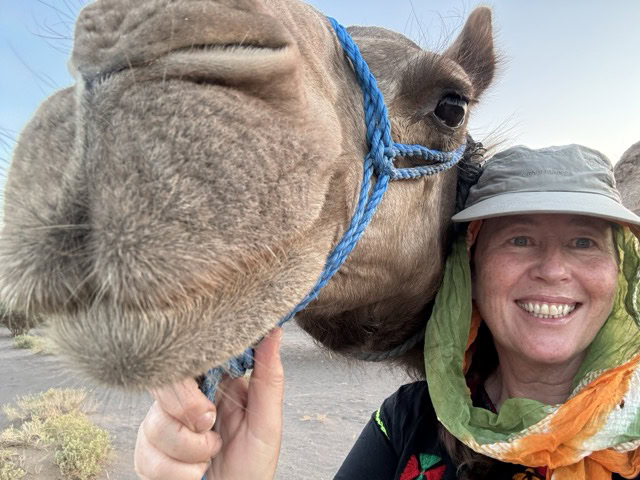
I am an explorer and writer specialising in Africa and the Middle Eaat.
I am the first recorded person to walk north to south Saudi, and the first woman to walk the River Draa. I speak fluent Arabic and am learning Tachelhit. I live in the Atlas Mountains.
I’ve written 4 books including Adventures in Morocco and Walking with Nomads. And I’ve cycled from Cairo to Cape Town.
Connect with Alice:
Website & Books: www.alicemorrison.co.uk/books
Podcast (Alice in Wanderland): www.aliceinwanderland.co.uk
Instagram, X & YouTube: @aliceoutthere1
Alice’s Morocco to Timbuktu expedition
Transcript
Mar: So welcome to the Solo Female Traveler Show once again. Today I’m joined by Alice, an adventurer, a writer, a television presenter with a very long career in the media and adventure world. Somebody who has undertaken incredible expeditions across some of the world’s most inhospitable landscapes to document cultures, people, and a planet in rapid change. Her journeys are driven by a desire to tell stories that connect humans rather than divide them and to explore places and communities that are often overlooked or misunderstood. Alice left a career in the media to commit herself fully to a life of adventure for real, not just for the Instagram. And since then, she has undertaken long distance expeditions on foot and by bike across Africa and the Middle East. She has cycled from Cairo to Cape Town, which is amazing, walked thousands of kilometers across Morocco, completed the Jordan Trail, and most recently has become the first person to walk the length of Saudi Arabia. which we will talk about more later. She’s also the author of several books, presented the documentary series for the BBC and host of the travel podcast Alice in Wanderland with A. Whoa, what a life of adventure, Alice. Thanks for being with me here today and I’m super excited to talk to you. And to get us started, I’d love for you to tell me a little bit more about where your passion and love for adventure comes from. Because I think in your case, it may actually be genetic.
Alice: Oh, Mar, thank you for having me on the podcast. It’s a real pleasure to be talking to you from my home here in the Atlas Mountains of Morocco, where we still have some snow and it’s actually really cold. So I’m wearing my Scottish woolen wrap. So, yeah, I think it is slightly genetic. My parents are really my inspiration and they when I’ll give you my mum’s timeline, because I think it’s quite interesting. She had she I was born on May 25th.
She did her law finals at university on June the 6th, and then she set off for Africa on a boat, because in those days it was more common to sail than to fly, in August. So she went off with her first baby, with my dad as well, I used to add Jim, with her first baby, never having left Scotland before, and she went off with my dad to live in the foothills of the Rwenzori Mountains in Uganda. So I started at six weeks old.
It’s incredible, because in those times, I can’t imagine that people knew much about faraway places other than through books and maybe some newspapers. And so, you know, what made her want to go to Africa at that time?
Alice: No. Yeah. Parents always wanted to travel, my mom wanted to travel, you know, they were of that era. So we’re talking about the 1960s, they were war children, they’d grown up in the Second World War. And I think that they were the first people in their families on both sides, my mom and my dad, to go to university, University of Edinburgh, where they met. And they were just naturally adventurous people, you know, and they came from a background, I think. where it was important to go out and see the world and do things and they wanted to and in those days people, for example, they were teachers so there were lists put up in the university notice board of positions available and they applied for Uganda.
Mar: Wow. And so you grew up in Uganda, isn’t that?
Alice: I did, until I was eight.
Mar: Okay, and what was it like? were your memories of that time?
Alice: My memories are very, happy and I think in a way I’ve come full circle because we lived in the mountains. I had an incredibly free childhood running around in the banana plantations up in the mountains, know, collecting frogs spawn to try and hatch into little frogs, going to the local school. Yeah, I loved it. It was so much fun. I’m glad you did it too.
Mar: I used to do that too, the little tadpoles.
Alice: Seeing the monkeys in the back garden, we had a pet goat and a pet owl and a pet tortoise. Every weekend my dad would drive us down to the Semliki Plains and we’d see the big game. And in those days, because it was before Idi Amin slaughtered all the animals, there were hundreds of elephants, hundreds of giraffes, dozens of lions, dozens of leopards, dozens of cheetahs. So I had a very, very beautiful and lucky childhood. And I think perhaps one really, really important thing is I grew up… I was the different one, but I grew up completely used to different people from a different culture with different languages, which of course I learned to speak. So my whole life has been one of seeing different faces.
Mar: and you being the one that is different from the rest, rather than the other way around.
Alice: Well, yes, and I mean that that is definitely a thing. So I think that definitely gives you a kind of a desire to observe and learn, which I’ve always kept with me.
Mar: And then when you went back to the UK to study.
Alice: So, well, we moved to Ghana and we had a bit of time between Uganda and Ghana, and then when I was 11, my parents sent me to boarding school because we didn’t have any schools in Ghana and they wanted me to get an education. So I went to a girls boarding school in Edinburgh called St. Denis and Cranley Academy for Young Ladies.
Mar: That sounds very proper, very etiquette.
Alice: Well, it was in, I mean, yeah, it kind of was, you know, it was meant to be, but I think it was the very end of those kind of schools. It was single sex, et cetera. And, you know, I think I was in the last, I don’t know, decade of those kind of schools being around. Most of the people in my school had parents abroad, either in the army or like my parents in some kind of service. Yeah, so that was a big change, big shock, honestly. And it…
Alice: transformed me in some way, I guess.
Mar: Suddenly you were with people who were more like you, I suppose.
Alice: Yes, I mean, there’s always, I think I didn’t notice that, to be honest with you, I didn’t really notice that so much. I think what I noticed was that suddenly I was on my own and I had to stand on my own two feet. Nobody was going to come and rescue me. I had to either survive that school or not survive it. And that was up to me. And that was a very strong realization on my first day as a border. I was alone. I was in this place and I just had to get on with it.
Mar: It seems that that may even have been something that you have been carrying all these years in all of your expeditions. Of course, you had teams and support, but it was still like a one person expedition across some really inhospitable lands. Not that the school wasn’t inhospitable land, but still you were alone.
Alice: It was. I think definitely, and I think many people have, I mean there’s so many people who have so many experiences with me, is when you leave your parents at an early age you become very, very independent. And I mean, I’m in the most lucky position because, you know, my parents were sending me away to get a good education. They loved me. They’re together. I came back for holidays. If you think of so many, for example, refugee children who are taken from their parents at such a young age, maybe their parents have been killed. You look at Gaza and suddenly they’re on their own. So I am not moaning at all. I had a wonderful, wonderful childhood and upbringing. But I do think that leaving your parents when you’re young does make you a certain thing and both a good thing because you’ve become very strong actually I think.
Mar: Right, because you had to depend on yourself and be independent and be resourceful. This is one of the things that people say you learn when you’re traveling solo, right? That ultimately you have to rely on yourself. You have to be resourceful. You have to solve the problems, whatever they come, right? Like you just have to find a way to make it work. Right, and so after that you started a career in the media, right? Tell me a little bit more about that.
Alice: It’s. Well said. Exactly, Mar.
Alice: Well, I got my first job in the media when I was 17, actually. I was an editorial assistant on What’s On magazine in Dubai, and I joined on the second issue. And now it’s a multi… I know, I know it’s now a multi-million pound business. And basically, I did a bit of everything. I was on my gap year between school and university, and I did everything from writing articles to putting the magazine to bed, as we called it in those days, doing the accounts, everything. And it was such an amazing…
Mar: wow, and that still exists!
Alice: opportunity to learn so much and it really, you know, you never know which thing that you do is going to send you on the right path, but that one definitely sent me on my path.
Mar: Right. And then you returned to the UK to work for the BBC as more of a news editor, isn’t it?
Alice: No, I returned to the BBC, to the UK to go to university at the age of 18. And then I went to university. Before university, so then I went to university, I studied Arabic and Turkish, then I went to live in Egypt for a couple of years. Then I came back to the UK and I worked in trade magazines, I worked on an Arabic TV news channel, and then I worked at the BBC. You don’t just get to be a news editor at the BBC at the age of 18. I wish.
Mar: Right, because this was before university, of course.
Mar: Exactly. So you worked in an Arabic speaking TV news. Were you an anchor? Were you a presenter?
Alice: Yeah. No, I wasn’t. wasn’t. My Arabic wasn’t good enough and I probably didn’t look good enough either, to be honest. The Arabic news presenters are all really beautiful, beautiful. The women are absolutely stunning. But yeah, I worked as a producer and then I was a senior producer. And so my job was to do the news, you know, to write the stories, to write the links to. in the gallery where the news goes out to say what you do and what you don’t do for the presenters. it was a very interesting experience.
Mar: Right. That career in the media, do you think that adrenaline rush of running the media, of like listening to the news and always being on top, do you think this may have been the first steps into that adrenaline addiction, if I may call it, of like being constantly on adventures that may be life threatening? When I read some of your books or your interviews and I read about your adventures, I’m like, wow, like I would be scared all the time of like, you know, a spider. biting me a snake, biting me a heat stroke. I don’t know, some person thinking that I am in their land by mistake. There’s just so many things that can happen when you’re adventurous in somebody else’s land that you may not be familiar with and you’re on your own, like as a person walking rather than in a car or on a plane or on a train. Do you think that adrenaline from the news may also be the beginning of that adrenaline and that rush that an adventure may also bring?
Alice: Gosh, do you know, Mar, that’s a really interesting question. I’ve never been asked that before. Well, actually, it’s very interesting to me because, you know, I was on 24 hour news, so our deadline was that second. So it was very, very, very fast. you know, one of your major judges of success was were you first? Were you first? Did you beat CNN? Did you beat Sky News? Did you… So it was all very, very fast. And actually I left it partly because I felt I was getting hooked onto that adrenaline and I was just really bored when nothing was happening. I was like, can’t there be some disaster, which is not healthy. And actually for me, adventure is rather slow and not full of adrenaline because the adventures I do are slow travel. I’m walking or I’m cycling. So they’re very, very slow, but it’s…
Mar: That’s true.
Alice: quite an interesting point that you’ve raised and there is definitely something about being hooked on doing the next adventure, the idea of excitement and planning and getting ready and scaring myself. I definitely am a person who, I don’t know why, but likes to frighten myself into doing things and put a lot of pressure on myself. So maybe you’re right.
Mar: Do you like amusement parks as well?
Alice: Yeah, I do. I don’t get to go to them very often and I scream like a four-year-old child, but I like them. Yes. I’m like,
Mar: Ha ha ha ha!
Mar: Because that adrenaline rush, right, Normally when we think of adventurers in the social media sense of the word nowadays, right? We picture young backpackers setting out to see the world with no plans, no objective. However, your adventures started more at what we would consider an older age, more or less my age now, right? After a successful career in BBC and other media companies, but also after a career in your own company, in your own media company as a CEO of your own company, where you just decided to… leave it all behind and start on these adventures with well thought out plans, with support teams, with permits, with funding, doing things the proper way, not just like, know, winging it and showing up somewhere without knowing whether you need it. You could be there or not. How would you describe this kind of modern day explorer and how does it differ from these adventures we see on social media that are probably not as adventurous?
Alice: Wow, that’s another great question. So first of all, I would just like to say that even all through my life, so even when I was working in the media and as a CEO, I used to do in my holidays, I went on adventures often as on my own, but with a group. So I would like join someone like Intrepid Travel, who do these amazing trips all around the world. And that’s how I enjoyed my holidays. and I would do cycling across Dorset on my own in February. Bad idea, it’s so windy and icy. So would always do, if you like, micro-adventures. But you’re right, my first big adventure wasn’t until I was 47 when I cycled across Africa. So I mean that, and that was a long time ago. So that was the first big one. How are these adventures different? I think… I think there’s room for every adventure. Let me just say that. you go outside your door now with your eyes open and do something that’s slightly difficult for you, you’re doing an adventure. If you walk up to someone in the street and say hello and try and make a connection, that is an adventure. Life is full of potential adventures and I encourage you to push yourself out of your comfort zone, to open your eyes and your ears and just approach life in that way because it’s incredibly rewarding. Honestly, it is. But for me… Why do I do these big organized ones? I think I like, I also do small, you know, like today after we finished this podcast, I’m going to walk up the mountain behind me for 14 kilometers. So I also do it impromptu, but yeah, you’re very, you’re right. I’m very different from the Instagrammers. Of course I’m older. So I have a lot more life experience to bring and I also don’t have a lot of time to waste. So I want to do the really big things and the really big things take a lot of planning. You know, Saudi took me two years, full years of planning before I got to the start line, before I got to the start line, and then a whole year to do it. Two years of planning and then a year of expedition with a break in the middle. So I think for me, I’m also a very ambitious person. I’m a huge type A personality. So as I’ve gone through life, I want to make an impact. I want to share my stories. I think I have a…
Mar: And then two years, right? In two seasons, right?
Alice: an interesting, I hope, gosh, I shouldn’t say that. I think I have a different perspective.
Mar: No, it is interesting. I I’ve listened to all of your podcasts, like book, like every part of your books, like they are extremely interesting. I find it extremely interesting.
Alice: thank you, Mar. But I think what I bring is that observer and also, you know, I speak, I speak or I learn the languages of the countries I’m in. So I really try and make a connection with people. And I like to be somewhere for a long time. That’s my ideal is to go somewhere, even if it’s only a week of walking in the mountains in Tenerife, for example, which I’ve done. Actually, a week, I could learn some Spanish. I could get to know a little bit about Tenerife, I could see the volcano, could connect a little bit with the country and the people. So I think I do these very big things because I’m ambitious, because I do believe I have something to share, and and because they’re amazing. They are amazing. You know, three months in a tent is just fantastic. So I love it.
Mar: I love the passion that is obvious on everything that you do, right? Like it’s obvious you’re committed. I also love the preparation. I’m close to the age of when you started your expeditions and if I was to do something like this, I would absolutely plan everything just because I would hate to waste time at borders or needing permits that I don’t have and not being able to do things that I wish I had the permit for and like, you know, knowing the right people. I would absolutely do it like that. I cannot imagine just turning up and like hoping for the best. That’s not my idea of an adventure, even though a lot of people think that that’s an adventure, right? Like not knowing and just like showing up. For me, this is just like a waste of time, right? But when I look at, of course, right? Like why would you waste three days waiting for a permit somewhere in some office somewhere where you could have gotten it in advance, right? And when I look at all of your expeditions, I feel like I could be talking to you forever, right? Like you, I have a bit of an inexplicable fondness for deserts that I can’t quite explain. that there is one trip that specifically caught my attention and that was your expedition to Timbuktu that was part of the BBC series. Timbuktu has always been my ultimate wishful destinations. It’s like that far away place that I haven’t been to because of security concerns in the last 20 years. But tell me more a little bit about that trip that was one of the first ones that you took. This has been a few years now that you went there.
Alice: Yeah, yeah, was 20. We filmed it in 2017, so that, you know, time goes on. That was. I’ve written a book about it actually called Morocco to Timbuktu. That was an amazing adventure. So I was very lucky in that I worked with a great TV company in Glasgow called Turn Television. And they pitched the idea to the BBC who took the idea, who bought the idea. And we did a trip from Tangier in the very north of Morocco overlooking Europe, only eight miles from Europe or eight kilometers from Europe, I can never remember. And then all the way down to Timbuktu. What I loved about that journey was we were following in the paths of the salt traders because in the great days of the caravan trade, say the 1500s roughly, salt was as expensive as gold. And salt changed the world. If you imagine, before people used salt to cure meat and to preserve food, they could not travel as far. You could dry meat, of course you could dry meat, but if you think of quantity, salt actually changed the world. So it became incredibly important. And I was following it in the footsteps of people from hundreds of years ago. And I was using modern methods of transport, of course, and doing it differently. But I think it was very, very kind of… there were so many… Like one night I stayed in a caravanserai in Fez. And a caravanserai is where the old caravans used to park their camels underneath and then sleep above. And I stayed there, I just went and slept the night in one of these caravanserai. And what was fantastic was it was still populated by families. And now underneath they have shops, they have tourist shops, like carpets and, you know, woodwork and pottery. And they also have like artisanal workshops. They work there, they make their products. But they’re still… echoing the lives of those traders who were bringing trade back and forth. So I think the thing about Timbuktu was that journey. And then I know you want to hear about Timbuktu itself.
Mar: Well, I imagine like the arrival, right? Is that like the treasury in Petra where you kind of like arrive somewhere and then it’s like.
Alice: No, it’s rather different. So the only way to get… I’m afraid I’m going to shatter those dreams, but I’m going to give you a good ending, a happy ending. So we arrived in Timbuktu and it was… We arrived at the airport. We had to take a United Nations flight, an aid flight, because everything is closed. It’s a very, very dangerous place, Timbuktu. Al-Qaeda, ISIS, Islamic State, they’re all in the desert. It’s bandit country.
Mar: Hahaha!
Alice: They smuggled drugs, arms, people, cigarettes, alcohol, all up the Sahara. So around Timbuktu, it was very, very dangerous. And Timbuktu was invaded by al-Qaeda, who treated the inhabitants. They beat the women. They forced them into marriage, which is basically just rape. I mean, it was terrible. The stories were just… They wouldn’t let them play music. They wouldn’t let them repair their own mosques. dreadful stories and the Timbuktuans are the nicest people ever. So we arrived at the airport, we got into the center of town and we could only stay for eight days because of security because the threat of kidnap was very strong. They kidnap you and then they sell you. So somebody will kidnap you for money and sell you to an Islamic fundamentalist group who will try and get money from your own country. So, but what a beautiful place. So I want you to read the book, I want you to try and look at the series is still on YouTube if you look it up. So I don’t want to spoil it, but two of my favourite things. One, we went into the great mosques. Now the great mosques were built hundreds, thousands of years ago actually, and they’re made of mud, compressed mud, adobe. So every year they have to be repaired because when it rains they melt a bit. But they are just amazing structures. And I remember going inside and the Imam came to meet us. And because I speak Arabic and I’ve learnt quite a lot about Islam.
Mar: great.
Alice: You know, I could have such a beautiful conversation with me. And I remember I have a picture of the Imam reading a bit of the Quran to me, sitting cross-legged in this beautiful mud mosque with just the light shining down and the little pieces of dust like gold in the light. And I mean, really, what a place. And then my other memory is that if you want to be really like Shishi and chic in Timbuktu, you take a three donkey cart. three donkeys. So that’s my top tip if you want to look the part.
Mar: hahahaha
Mar: Fantastic, fantastic. I I’ve seen lots of photos of the mud mosques and of the architecture and I don’t even know why Timbuktu is like a place of maybe because as a little girl, I must have read something about it and that name stuck with me because it’s, I don’t know, it’s a name that has a ring to it. I don’t know. So it’s always been this dream place, right? So when I saw that you went there and yeah, not like 30 years ago when things were perhaps different, but now that they are still, like you say, unsafe, right? It’s unsafe to go there. You have to go on a UN plane.
Alice: Yeah. Yeah.
Mar: or some people that are true a little bit more crazy adventures go up on the boat that relies on water being there. And so I can imagine eight days there with a crew filming you. That must have been extra interesting, like more people around. I can’t imagine that that many TV crews go to Timbuktu recently. So it must have been quite the adventure.
Alice: No, we had to pay. We took security from the UK, a company called Secret Compass, and we also hired armed guards. I think we had eight armed guards. So if you get to see it and you see me wandering around talking about the beauties, what you don’t see is the men on the roofs on either side of me with weapons. Yeah. No, no, no, it’s completely serious. I mean, to be honest with you, I had to sign a lot of documents and say that I was doing it at my own risk.
Mar: the people behind and the people above. Yeah.
Alice: And I was nervous, I was frightened a little bit because I mean we’ve all seen the Al Qaeda videos, I didn’t want that to be me.
Mar: Right, you didn’t want that to be the ending of the documentary series and I’m surprised that the BBC was up for it as well. I mean, it’s wonderful to be able to go.
Alice: They took a lot of good, they took great care. They took very great care of us and we did a lot. I mean, the BBC is an excellent, you know, in terms of safety and rigor, it’s an excellent employer because it really does try and take care of you. And it says, you know, I mean, they said to me, are you absolutely sure? We want to check with you. You know, there is a risk, et cetera. So no, complaints.
Mar: Wonderful. And you’ve mentioned that the people from Timbuktu are very nice and hospitable. And you’ve traveled through many places where hospitality is not just kindness, but also survival and tradition. I don’t think anything defines hospitality like most of the Middle Eastern countries and Northern African countries from experience, I’m saying. But what have you learned from being welcomed, helped and cared for by strangers across so many different landscapes and cultures?
Alice: Well, one, I’ve learned that what you read in the media and what you experience in real life are two different things. And I come from the media, so I say that, because what you read in the media is politics and governments, and what you experience is people. The second thing is I’ve learned to be more generous and to be more open-hearted. And thank you to everyone who’s taught me that. And the third thing is that people are all the same. We’re all the same. Of course, we’re different personalities and different… religions, colors, race, gender, age, but our humanity is common. And, you know, the most important thing is to respond to people as the human that you are and to take them as the human that they are. And we all make mistakes. We all get angry. We all get irritated. But really, hospitality, when someone just opens up to you and, you know, makes you tea and gives you dates and welcomes you to the fireside and you exchange stories. of your lives, that for me is the 100%, one of the very, very top three best things about traveling. And, you know, if you’re traveling solo, I mean, I should say on these big expeditions, I’m with a team, but if you’re traveling solo, it really does give you an opportunity to meet people and to open up to them. And that would be my strong advice to anybody is open up to the people around you.
Mar: Right, it always makes me a little bit sad. As you can imagine, the most talked about topic in our online communities and with our audience is safety. And while safety is obviously very important, especially if you are alone as a woman, you may be more of a vulnerable target towards others who may be looking for easy targets. Still, what makes me really sad sometimes when these conversations come up is always this fact that they are missing out on the opportunity to meet somebody because they see strangers as danger rather than an opportunity to connect. And while it’s true that women may be more vulnerable and easier targets, it’s also true that like you say, a person saying hello or you say hello to somebody or even just smiling could be the beginning of an amazing experience and an amazing moment with somebody who’s just opening their door to you and offering you dates and tea and striking a conversation with you about something else. And traveling is this opportunity to connect and to learn and to see people. and to see different perspectives. So it always makes me a little bit sad when people talk about safety in the terms of like always protecting yourself and always avoiding contact with others. While the best thing about travel is precisely this, right? So it makes me a little bit sad.
Alice: you make a very good point.
Mar: Yeah, you’ve spent, also as a woman, spend a lot of time in communities where gender roles are maybe a little bit more clearly defined than where we come from. And where women don’t typically undertake long distance expeditions, so you’re probably even more of, you know, a strange role model for many of these communities that you may be meeting. They may have never seen a woman undertaking these long distance expeditions. There are also communities where foreign women may be perceived as honorary guests. I don’t know if this is something that you’ve experienced. I’ve experienced it personally myself because I’ve lived and worked in the Middle East for many years. And you’re almost seen as a pseudo male, as somebody that’s almost non-genderized. You’re not a woman. You’re a foreigner. that accords you a different status, a different role, and especially in Muslim or Middle Eastern countries. And I’ve worked there in a professional capacity. And I always felt as a foreign woman, I had access to both men and women, which my male colleagues did not have. And that’s something that’s not talked about. People always will say like, in Middle Eastern countries, in Muslim countries, in Islamic countries, women are seen differently. Yes, but that means that you have access to the women and the men, which men do not have access to. Do you feel that way? Have you also felt in the same way when you were traveling in these communities?
Alice: And I would say that’s my superpower. I honestly think that’s my superpower. The countries I’m really interested in, the roles are completely gendered. Especially amongst… Now it’s changing amongst the much younger people, like the early 20s teens. But really… Of course it’s different between the city and the country. That’s a big difference. But yeah, roles are completely gendered and you’re right. I feel like I’m treated as an honorary man by men. And I am of course allowed access to women and mean nowhere was this more important than… Saudi Arabia, honestly nowhere. Maybe Timbuktu, I spoke to a group of women who had been forcibly married to al-Qaeda soldiers who’d taken them by force and married them and then left them when they were driven out of the city without even divorcing them. So they were trying to find a way that they could get married again. These were all very young women and a man would never have been able to talk to them about what had happened to them and I was. But on a more kind of upbeat, happy side. I mean, love meeting women, you know, meeting my own gender in different countries. It’s really fun because my guides are almost always men, which I also like. But yeah, that’s a really good thing. So for example, where you see me living now, I live in a family compound in the Atlas Mountains where they speak Tashelhiyt which I’m learning, not Berber, sorry, Berber, not Arabic. And here there are four families and this is my little kind of house flat above. And I spend all my time with the women and children because the men are not in the dar They go out to work. They come back in the evening to eat. They go to the mosque. They’re not around and you don’t socialize with them. So here the social life is all women. So I get, you know, I get that perspective.
Mar: Yeah, and you were mentioning Saudi Arabia, which is your most recent expedition. How did you see the differences between the rural and the city areas in Saudi Arabia, which has seen so much change in the last five, six years, right? I was on the first plane when they started to give tourist business to women, well, to tourists in general. So in 2019, just before the pandemic, I went to Saudi on that very first plane. know, there were media people waiting for people to arrive on planes as tourists for the first time. And this is me after spending 15 years seeing my colleagues working in Saudi Arabia, male colleagues, but then later on also female colleagues. So I’m curious to see what you saw in your expedition, in your most recent one. How were the cities versus the rural areas evolving and how did you see this since you just brought this up?
Alice: Well, I think Saudi is undergoing a complete cultural revolution. I think it’s a fascinating country to go to. I would really encourage anyone to go. And actually, if you’re particularly interested in women, did part, I wrecked a part of Intrepid Women’s Tour to Saudi Arabia. So I could specifically, yeah, so I could specifically meet women before I went for my trip, for my expedition. I think the difference between the city and the country is…
Mar: Okay, interesting.
Alice: absolutely enormous. mean this revolution is taking place everywhere. So in the cities, for example one of my first visits to Riyadh I went to the first ever, the opening night of the first ever Saudi opera. It was fantastic, it was absolutely amazing and I was sitting between two women, also on their own because I was on my own and I was wearing, I’m very, I’m very
Mar: wow.
Alice: very careful. I wear an abaya, the black robe, and I wear a headscarf in Saudi Arabia or I wear a long dress, long sleeves, and I wear a headscarf all the time. And why do I do it? It’s not obligatory. I do it out of respect for the country I’m in. And I really believe if you go to someone else’s country, you know, find out what their customs are and try and respect them a little bit because you have a better time as well, as well as being a better person. But I went to the opera and I sat beside two women. One was in full black with the cap, you know, the veil that so you could only see her eyes. And one was in trousers and a top and she was wearing like an open, really colorful kimono, no headscarf, both Saudis. And I said, my God. And there was me in the middle because I was wearing an abaya and a headscarf, but colorful. And I said, gosh, you know, and they said, yeah, we can, you know, we can wear what we like now and we choose, we are choosing which we’re most comfortable in. So that was great. So that’s an example of Riyadh, know, where I was going to the opera, I was staying at the Boundary and Oriental Hotel, I was like having this amazing life. And then I went to my expedition where I’m walking across the wilderness. And I’ll tell you something that happened to me that, well, it happened to my team that really made me laugh. So I’m walking with a team of men, Shaya who’s walking with me, became the first he… He finished after me and I invited him to share with me. So he finished after me. So he became the first man, the second person to cross Saudi Arabia, the first man and the first Arab and he’s Saudi. So it was very significant for him as well. And we were walking together all the time. So it’s five men. Well, it’s me and Shaya. And I think that day Abu Ahmed was with us with the camels. So we went past the little mosque and there was a lady behind it waving at me. So I went over and I went into their Majlis, their sitting room. And her father was sitting there, the fire was on, they were making bread and they had dates and coffee and she was like, oh, come and talk to me, blah, blah, blah. So I was chatting away to them and suddenly Shaya came into the room. Now Shaya can’t see particularly well if he changes from light to dark and the room was very dark, we’d been in very bright sunlight, obviously. He comes in and the woman who was probably my age and who was wearing a headscarf and niqab cowered behind her father like this and her father shouted out, OI! OI! Abu Ahmed, Abu Muhammad, which means OI you stop! And Shaya was like, what have I done? And I just, I, I shouted Har- Harim, means woman, Harma, which means woman. And Shaya went like this, he went-
Mar: wow.
Alice: he put his hand over his face and he ran out the room. Now, this is it, this genuinely happened. The point is, and Shaya was afterwards, he was so embarrassed. He was like, you have to go and apologize for me. He hadn’t seen that there was a non, obviously a woman in the room. Now, even though she was completely covered, it is not normal in that culture for a non-family man to enter a room where a woman is. It’s absolutely not normal. It’s like, and her father, I mean who must have been in his 80s, was trying to defend her because it’s just so against the culture. And I think this gives you very much a contrast between the two sides.
Mar: Right, right. And I can imagine that there are situations like this every day because Riyadh and Jeddah are very modern cities, especially Riyadh with all the businesses, all the foreigners, all the expats, all the international community. Even in 2019, just before just the Saudi was opening, it was still mandatory to wear an abaya So I still wore an abaya It was no longer required to cover your head. So I did at times. And I still experience some of these situations where, in a transition period, you still don’t know, some people don’t know what’s expected, what’s not expected. Some restaurants still had family areas where women alone need to go to.
Alice: still yeah yeah still have that look I think
Mar: Yeah, but I think it’s not mandatory, right? Yet? Anymore?
Alice: No, it depended on what was happening. There are, I mean, you know, we don’t have time to go into the difference in cultures here. But what I would say is, you know, do have a look at Saudi Arabia, fascinating place and. Whenever you go, I mean, I think in order to really enjoy a country when you go to it, you will enjoy it more if you do, if you don’t go in with me, me, me. I want to wear shorts and a vest. I want to drink alcohol. I want to anything. It doesn’t matter what it is. But if you go in with a more nuanced thing, still enjoy your holiday because it is your holiday and your travels. But I think if you go in with the attitude of I’m a guest in this country, how can I I make other people comfortable with me, you are going to benefit so. And honestly, most people do this naturally. think most people naturally are really polite. Most people are very aware and most people naturally want to approach other people politely. I think that’s true. But it’s definitely worth taking a few moments to research where you’re going and try and just try and approach other people. you know, because it’s their country in the end and it’s their culture and you’re just visiting.
Mar: Yeah, I fully agree with you. I think that it just makes you more comfortable. It makes everybody more comfortable. It’s also sometimes an opportunity to strike a conversation because people will ask you, will see that you’ve made an effort, that you’ve read about them. And in the end, that will lead to better opportunities for you to connect with people just because you’ve made the tiny little effort to, when in Rome, do as Romans do. So it’s helpful in any environment, whether it be a country that’s different to yours or whether it be a business meeting or whether it be anywhere really.
Alice: Yeah. Yeah. Yeah.
Mar: But going back a little bit to your Saudi expedition, how did you plan it all? You said two years. Where does that one even start to plan about this? And I’d love to hear a bit about the practicalities. Like how did you actually plot the route? How did you decide what you were going to wear? Like, I don’t know, I find it amazing. You had camels helping you. How did you find the camels? I don’t know. Tell me a little bit about that.
Alice: Okay, you know, honestly, Mar, my life is, I love my life, as you can see, but, you know, I’m on my own. I have to create everything from me. I create the trips, I create that, like everything has to come from me, which I love as well, because I’m quite egotistic. However, you know, that also means that the work. I started thinking about Saudi when I was in COVID. I was going to do originally Jerusalem to Mecca. And in fact, I walked the Jordan Trail in the middle to do part of that journey. But then all sorts of things happened. I was going to walk the Palestinian Heritage Trail and then October the 8th happened and then Israel slaughtered 70,000 Gazans. So, you know, that was not possible. And then as I was working with Saudi Arabia, I began to realize how difficult this part of the journey was going to be just to find anyone to do it. Because this is all very new. Well, in fact, I hope that no one else in the world has ever done it in the modern kingdom of Saudi Arabia. finding people to work with was incredibly difficult. And then once I found them, everything started to really happen. the two things that were most difficult about planning the Saudi expedition were getting sponsorship. and finding the right people to work with. And if you read any of my blogs, I have all the details of who those people are. mean, Khaled Al-Rabiah from Mad Adventures was my logistics manager. Alan Morrissey did all my route planning and navigation. So those were my two absolutely key people. And then Shaya ended up walking with me, which was amazing. And then for sponsorship, I had the Royal Commission for Al-Ula. I had Gym Nation and I had Saudi Tourism Authority. And Just to put this, just so you know really how this works, I knew that I would have to cash flow this adventure and that I’d have to pay for it upfront. So I sold my flat in London and I used that money to cash flow the adventure and to also pay for a large chunk of it because I couldn’t get enough sponsorship to pay for it because I had five men for 112 days and two camels and three vehicles and all the food and all the water. I mean it was hugely expensive. But I backed myself and that’s another thing I would say to everybody especially, back yourself. Back yourself. If you believe in yourself, put your money or your efforts or your power where your mouth is and just do it.
Mar: Right, wow, that’s amazing. Yeah, this is a very good understanding of the magnitude of something like this. And now looking back, is there anything that you would have done differently if you were to do this again?
Alice: Well, I you I tried full effort all the time, so no. Yeah, I’d have worn different shoes. learned I made a big mistake with my shoes on stage one and my socks. Actually, my socks were my shoes. I wore thick socks. I got blisters on the first day. I suffered horribly, horribly for most of the first expedition, four weeks of absolute agony. So, I mean, really, that’s the one thing I would change. But even that, wouldn’t change. You know, your story’s your story. The good… and the bad, you cannot tell which is going to lead where. And I couldn’t have done it any differently. I gave it my 100%. My 100%.
Mar: And, and now where can people follow that expedition? That’s on your blog and on your podcasts, but are you, planning to write a book? Are you planning to do a documentary series? Did you have like some filming? You film yourself.
Alice: Both. I filmed everything. I took Osmos with me. filmed it. Alan, who was doing our navigation, also filmed for me. We had a drone. So we’ve done a lot of filming. And I had a camerawoman join me for about a week, which is fantastic. Alicia. So, yeah, where can people follow me? I mean, I know you’re going to put these in your things, but my podcast, this series, followed the whole expedition and I followed the last expedition as well. All my expeditions were on my podcast live from the road. And I love them because it’s… I’m doing it on the day, you know, sometimes I’m walking as I’m talking and that’s Alice in Wanderland with an A, W-A-N-D-E-R-L-A-N-D and it’s a picture of a camel and me so you’ll know it. My blog, everything’s on alicemorrison.co.uk and I am @ AliceOutThere1 on social media X, Instagram because there’s lots of photos, you know. I post as I go, if you want to get a flavor of it, if you like photos, look at Instagram as AliceOutThere1. If you want to listen to the podcast, go to Alice in Wanderland. If you want to read the blogs, if that’s your preference, alicemorrison.co.uk. Thank you for letting me plug all of those. And yes, I’m…
Mar: Of course, of course, because you need to go and see to actually understand what you’re saying.
Alice: Yeah, I hope so. I really I posted a lot of content and you know, it’s stuff you’re not going to see anywhere else. I’m not an influencer. I’m an explorer. I love it.
Mar: Exactly, so it’s very raw, it’s very authentic, it’s exactly what’s happening, right?
Alice: Yeah, it is. I’m very red and sweaty and tired and my feet are bleeding. But I mean, that’s the truth. And then sometimes I’m just like so excited and speaking at a thousand miles an hour and going, look. And then there’s lots of pictures of the camels, Juicy and Lulu, which is always worth a look.
Mar: And I think it was one of your podcasts that I listened to that you were talking about what you learned about camel sex. You know, before we finish, I’d love to hear a little bit more about some other fun anecdotes from the expedition, the funniest moments that you’re like, I can’t believe this is happening.
Alice: god. I mean, the thing about Saudi Arabia that I think people probably don’t expect is that the people have got a really, really good sense of humour and they like a joke. So I remember once I was sitting writing my notes and I just looked up and two of my team members were carrying my whole tent past me. Just carrying it. And I was like, what are you doing there? And they were just like, oh, we’re just carrying your tent. And it’s things like that which are really obscure and like in the middle of the desert. Shaya and I, when we were walking, we had long, long hours of nothing, know, nothing, nothing, just sand and wind. And we would just do silly walks or pretend we were walking along the Hejaz railway. Shaya would pretend he was a train conductor and be going, and running around the track. So lots of silliness. then just. Every day was something new was brought up and the camels are by their very nature, very funny animals. They’re very intelligent and they’ve got great personalities. And from this trip, on my expedition across Morocco, which I wrote Walking with Nomads, I’ve got lots of camel sex facts because male camels are highly, so listen, ladies, if you want to understand anything about men, like human men, read my book. through the camels, you will understand everything you need to know. I did not understand how fundamental, sorry, this is gonna sound really weird. I learned more about men from camels than I ever learned in my whole life. When the camels, it’s male camels go on heat. When they’re on heat, their stomachs physically shrink so that they don’t have to eat as much so they’ve got more time for sex. That’s all you need to know.
Mar: Priorities.
Alice: The sex drive in the male is just hilarious and it’s the only thing. When the camels are in heat, they can smell a female camel from like a kilometer away. And what they do is they have a big pink bubble in their mouths of flesh, which they fill with foam and they blow it out of their mouths and they roar like lions. So they have this big foam bubble. And if you’re walking in front of them, you get a shower of sex foam, basically. And then what they do with their teeth
Mar: my God.
Alice: I know, what they do with their tails is they spread their back legs, this is male camels, they pee and they make their tails go like helicopters to put the pee on their backs because apparently women, camels like that. So camels are camels. But they are a very interesting insight.
Mar: Is that helpful? Because I mean, if they can smell a female camel from a kilometer away, then they know if there’s other people nearby, that could be a useful skill in the desert.
Alice: Well, yes, can be. Yes, it can. And I mean, that is definitely a very good point. I like it. I like the way you’re thinking.
Mar: I’m thinking survival. I’m like, camels could be useful for spotting other camels that may be useful for like water and help and I don’t know or bandits, you know.
Alice: You are! I love it! Well, and milk, and milk actually, if you think about it, because they’re smelling female camels.
Mar: right, right. Well, I guess that these are some of the fun and interesting facts that people can learn by hearing your listening to your podcast or reading your books or reading about your expedition. Very useful facts for, know, in case you get dropped in a desert somewhere and like need to find other camels, find a male camel first and then he will help you find the other camels. Pretty useful.
Alice: Mar, I love the way you’re thinking. You are a survivalist at heart.
Mar: I am made for taking all these expeditions. I have to say that when I read these expeditions, I’m like, this is amazing, but there is no way I would do it. Especially when I was reading your Cairo to Cape Town cycling, and you said that you basically were thrown into it without a lot of training behind at more or less my age. And I was like, wow, could I do this? And that was like a fleeting thought that very quickly came to like, no, no way I can do that.
Alice: You are.
Alice: Well, I’m just going to pick you up on something here. You say you can’t do that. Well, no, you physically can do it. You really can do it. Whether you want to or not is a different issue. But I really wish that people in general wouldn’t say, I can’t do it. And think, you know, if they want to do if you want to do something, you can do it more or less. I mean. You know, within reason, obviously it would be hard for me to become an astronaut. But I guess if I really, really wanted to, I could find some way to inveigle my way onto a Virgin flight or something. But the point is you can do things. But you have to want to do them enough. That’s the difference. You have to want to.
Mar: Yes, I think you are absolutely right. When somebody tells me, I don’t have time to do X or I don’t have time for Y, the reality is that you’re not making it a priority. It’s a little bit within limits, of course, when somebody says, I cannot travel because X. No, you’re just not prioritizing. I don’t have money for travel. Well, if you really prioritize it and save on everything else, you’ll be able to make some budget that maybe allows you to take a weekend trip by train somewhere nearby. And that’s a trip that you can take, right? So it’s a matter of priority and how badly you really want it. If I truly wanted it very badly, I could probably get on a bike and start cycling. And I would probably regret it every minute for the following however many days is required, but I would probably do it. I’m just not that kind of person. When I see somebody saying, I’m going to run a marathon, my first question is, why would you want to do that? I just don’t like uncomfortableness, I think, is my personality. But I think this is a great.
Alice: Which is fine, which is fine. And travel the way you like to. mean, nobody is, nobody cares. Do what you like. Nobody cares. mean, literally, you know, I love speaking on podcasts because like my family are so bored of all my trips. They’re like, yeah, let’s talk about me now. So nobody cares what you do. So do what you want to do. That’s my secret to life.
Mar: Absolutely, people like, what if I am eating alone and what are other people gonna think? Other people haven’t noticed you. They don’t care about you and you shouldn’t care about them. I think this is definitely something very important to learn. Other people don’t care about you. You shouldn’t care about them and it doesn’t matter. It really doesn’t matter. Just do what you want to do, however you want to do it. And I think this is a fantastic takeaway. from our conversation and I can see that you definitely did what you wanted to do, however you wanted to do it. where are you hiking to today? Is there something specifically that you’re doing?
Alice: Well, I hope so. the mountain behind me is like, I want to hike it today, but the weather, as we’ve been talking, I don’t know you can see, it’s got dark. Here in these mountains, it’s very dangerous to walk in the rain. There are a lot of landslides. So I’m actually going to just pause for, I haven’t had breakfast like this, so I’m going to have my breakfast and wait for maybe an hour, because if it’s raining, I won’t walk. Or if I think it’s too dangerous. We lost three people to an avalanche two weeks ago. Sadly, Allah yerhamo Yeah. And also I’m a bit lazy. So if it rains, I’ll be like, I’ll put the fire on. I’ve got work to do. I’ll do that instead.
Mar: Somehow, I don’t know that lazy is the word that I would use to describe you after all these expeditions.
Alice: no, God, I’m so lazy. No, Mar, honestly, my default, I’m so lazy. I have to push myself a lot.
Mar: So your default is couch potato, but then you become like the explorer that crosses deserts. It’s either one or the other. You’re either Cycling Africa or you’re sitting on the sofa with a fireplace.
Alice: trying to get better. I’m trying for my pendulum not to swing so much. the sun’s coming. Damn!
Mar: I think there’s hope. And then let me quickly finish so that you can go hike and maybe later on you can let me know if you hiked or not. But some quick travel related questions to end with. One random item that you cannot travel without.
Alice: Pen knife, a small knife.
Mar: Okay, and one thing that you forgot, and one thing you forgot and never again will.
Alice: with scissors as well.
Alice: I forgot and never again will. I can’t really think of anything I think one thing I forgot.
Mar: Do you have a packing list that you go through before every trip?
Alice: Honestly? No, but… God, that’s such a hard question.
Alice: I’ll tell you, no, one thing, it wasn’t that I forgot it but I didn’t think it through. A mallet, like a heavy hammer, to hammer in tent pegs. There you go.
Mar: wow. Wow. Okay. Good. And then tell me what you’re most excited about right now. Are you working on a new expedition? Are you just like taking it all in from this one, from this last one and like, you know, filming everything, recording everything, editing everything? Or what is it that you’re most excited for?
Alice: Well, I’m really most excited. I’ve got to benefit from this expedition. I’ve got to try and earn some money as well. So I’m working on a TV series and a book. So wish me luck. And if I can’t find a TV company to buy and if I can’t find a publisher, I will publish myself and I will put the TV series on YouTube. So that’s a really, really big piece of work. So I will keep everyone updated. Follow me and I’ll keep you updated.
Alice: And in terms of adventure, I always have another adventure on the go, always, but I’m not going to reveal it yet because I have to do it. So, but I will be doing something later in the year. And in fact, in May, you see this ridge behind me with the snow. This is called the Dog’s Teeth. So when the snow melts in either April or May, I’m going to hike it. It’s quite a dangerous ridge and I’ve looked at it for eight years now and not done it. So I’m going to hike that ridge, which will take about two maybe three days and we’ll need to carry all our own supplies, have some ropes. But yeah, so that’s my next immediate one.
Mar: Fantastic. So tell me once again where people can find all of your adventures and we will add everything into the notes and all the books that you have written and the TV series on Timbuktu for those images.
Alice: Okay, great. So my website, alicemorrison.co.uk or just search Alice Saudi or Alice Morocco on Google, you’ll find it. And that has links to everything. My podcast is Alice in Wanderland with an A, Alice in Wanderland. And my social media is almost all at Alice out there number one, AliceOutThere one.
Mar: Okay, fantastic. Thank you so much, Alice. You it was great to chat with you. These adventures and of course, I’m going to now go back and watch the TV series on Timbuktu so that I can see those images. And I hope that your hike today goes well and your Dog’s teeth expedition as well. I’m wishing you luck, like you asked for. And then we’ll keep an eye on your next expedition. I’m sure it’s going to be an amazing one.
Alice: Thank you very much, Mar