
Bali is one of the most visited islands in the world, but beyond the traffic, beach clubs, and Instagram photo spots, there is another side of the island that many travelers never experience.
In this episode of the Solo Female Travelers Podcast, Mar sits down with Henni, our local Bali host, to talk about what Bali is really like from a local perspective.
Mar has visited Bali 13 times over the last 16 years and has watched the island change dramatically. While overtourism, traffic, and destructive development have dominated headlines in recent years, much of Bali still remains untouched by mass tourism if you know where to go. One thing many travelers don’t realize before visiting is just how big Bali actually is, and how concentrated tourism is in only a few small areas of the island. With a little more effort and intention, it’s still possible to find quiet waterfalls, ancient villages, local temples, and incredibly beautiful places far away from the crowds.
Together, Mar and Henni discuss overtourism, influencer culture, spirituality, Balinese ceremonies, water purification rituals, and how travelers can experience the island more thoughtfully and respectfully beyond the crowded hotspots of Canggu and Seminyak.
Henni also shares why respecting temples and local customs matters so much, how tourism impacts local communities, and why supporting local women-owned businesses can make a meaningful difference.
If you’ve ever wondered whether Bali is still worth visiting, how to avoid the crowds, or how to connect more deeply with Balinese culture beyond the social media version of the island, this episode offers an honest and nuanced perspective from someone who calls Bali home.
About Henni:
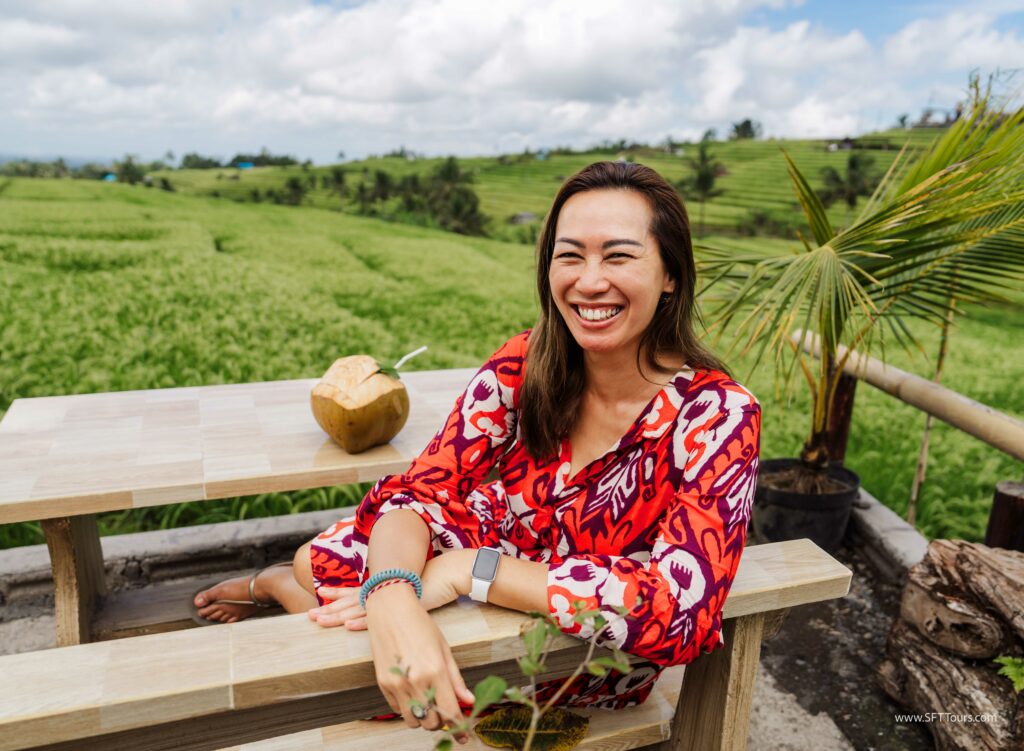
Henni is originally from a small village in East Java but moved to Bali at the age of 8.
The single mom of 3 has been showing guests around the island since 2017, after a chance encounter with a tourist inspired her to swap her baking job with one in tourism, and she never looked back.
Henni is happiest when she hears guests say “wow” with a wide smile and wider eyes. She loves meeting people, showing them her favorite places, letting them taste the best local foods, and sharing the Balinese way of life.
She also enjoys listening about other countries and traveling through her guests’ eyes, especially solo female travelers who share their experiences with her. Through their stories, she can feel how big, diverse and beautiful our planet is.
Henni is most excited to take you to the non-touristy places, the ones without Instagram spots and queueing for pictures, the real Bali through Henni’s eyes.
Brought to you by…
The Solo Female Travelers Podcast is sponsored by Solo Female Travelers Tours, our small, luxury, women-only tours that support female owned businesses around the world. Join us on a trip of a lifetime that helps make the travel industry more equitable.












Transcript:
Mar: Welcome to the Solo Female Travelers podcast. Today I’m joined by Henni, who is our local host in Bali. If you’ve traveled with us there, you’ve already met Henni. She leads all our tours there and plays a huge role in how our guests experience the island. Henni brings so much care into everything that she does. And so many of our travelers mention her name by name when they talk about what made their trip special. Born in Java, a resident of Bali since she was a little kid. Henni is also raising three kids as a single mom and building her own mighty business in Bali.
When Meg and I spent time in Bali in 2024 to create the itinerary for our women-only trip, we met several guides but immediately connected with Henni because of her humor, her care, and her values, which very much align with ours. I have been coming to Bali 13 times in over 16 years, and I have seen the island change dramatically. Not that it wasn’t popular in 2010 or before, but the level of tourism development that has happened since then has been exponential and has brought a range of challenges that the Balinese people are battling with.
As a result, Forbes placed the island on top of the no travel list in 2025 and cries of over tourism and destructive development have filled the headlines. In truth, some parts of the island are very busy and traffic jams make daily life very, very frustrating for the locals and for tourists. But the island is huge and tourism is very much concentrated in a very few spots, leaving most of the island still as it was pre-tourism boom. So today I am going to tell you that you don’t have to cancel your trip to Bali because of fears of over tourism and crowds.
And I am joined by our Bali host to spill the beans on the places you need to visit to connect with the locals and learn more about Balinese culture, minus the motorbike fumes and the photo spots. The opportunities to have a meaningful and thoughtful vacation in Bali abound if only you know where to go. And luckily we have the right person to talk about this. So without further ado, Henni, how are you today?
Henni: I’m over the moon and feeling much better seeing you.
Mar: It’s so great to see you as well. We haven’t seen each other since our tour nine months ago or something like that. So it’s been a while and it’s nice to see your face again. We’re also matching colors. We’re matching colors. This is perfect. So before we dive into the conversation, can you share a little bit more about yourself and how your tourism career started?
Hennie: Yeah, I know I miss you a lot and now you have a red lipstick too. I know, right.
Okay, so, hello ladies over there. Don’t cancel your trip, just book right now. Well, I’m Henni and as Mar said, I was raised and born in Java and I moved to Bali when I was eight, so when I was little. And my parents moved here and how I started this. I did baking before doing tours. Being a tour guide or tour host had never been in my head at all. I even never knew this kind of job existed, because it was a very lovely accident to be in this business. It started with a smile in 2017 at a coffee shop to a stranger. And actually, I remember, I will never forget his name.
His name is Tito and he’s from Spain. He was traveling in Bali and then it was his last night in Bali. We just made direct contact and he’s like, hey, how are you? And then we talked and then he asked me, do you live here? Something like that. Then we’re talking and then he said that he has been in Bali for a month. And then he asked me lots of questions, you know, like, what do you do? How do the kids go to school?
He asked me, can you take me to the airport tomorrow? And I was like, sure. And he told me the next day, Henni, I still have three hours before my flight, do you think you can take me somewhere? And in my head, I’ve never been anywhere. So where will I take him? And I was thinking, I said, hey, I love one place because there’s no people there and it’s a mangrove forest.
And then we talked a lot there and it amazed me that he travels a lot and traveling is not in our head. In Indonesia it’s not like you, you’re like now the young generation, yes, they travel a lot, but for people like me, this old, it’s not in our blood, it’s different. And I was like, wow, this guy has come, he flies here and to me like was like wow. And then he asked me lots of questions about Bali and I answered like a friend.
Then at the airport he gave me 300,000 IDR and I was like, what money is this? He said, this is for you, your first money. I was like, first money? Money for what? He said, first money, you have to keep doing this. I was like, keep doing what? He said, keep talking and driving. And I was like, what does he mean?
And then I talked to my father. I said to my father, you know, I met a weird guy. He said like this. And my father said, maybe it’s like my friend. He drives for people. I said, I don’t want to be a taxi driver. And then I started thinking, how can talking and driving give me money? It’s just insane. I didn’t know what this was. I knew tourists came to Bali when I was young. My father always took me to Kuta Beach and then my father doesn’t speak English until today. So he would just push me like, hey, say hello and say, how are you? You know, just that’s it. But I didn’t know what tourism was. I don’t know why these people were coming here, you know, it looked very different than where I’m from in Java. So yeah, it was a very good accident to meet that guy. And I wish him all the best. I don’t know what he’s doing. We lost contact. We don’t talk anymore. Sadly. Yeah, otherwise, he will be so proud to see me, and you know, with you, SFT.
Mar: So he’s Spanish as well. It’s kind of like a full circle.
Hennie: Yeah. He would work for a year because he’s an accountant. That’s what he said. He will work for a year, but he will quit the job. And he travels. He works again, then quits the job. And in my head at that time, how come? Because we don’t have that. In my head at that time, working is about nine to five. You go to the office; you are in a uniform. There’s nothing like this, that I will be here with my red lipstick talking to you, taking the ladies to a nice restaurant and talking about Bali. Never been in my head at all.
Mar: Right. Talking and driving, that’s a good definition of what you’re doing today. And 300,000 rupiah is about 20 euros, 20 dollars, right? Something like that.
Hennie: Yeah, but at that time it’s a lot of money, you know, it’s 2017.
Yeah, I should frame the money, Mar.
Mar: Yeah, No, absolutely. Just for, for our listeners who may not be familiar.
Hennie: Yeah, I should frame the money. I didn’t know. I wish I knew.
Mar: Yes, it was your beginning.
Well, there are about four million Balinese people and in 2025, seven million people visited the island. That was a record breaking year and tourism has been steadily increasing since your first semi-pseudo tour in 2017. And this number has been increasing with the exception of the pandemic years. When I visited Bali the first time, the number of tourists was less than half of what it is today. And I don’t remember the traffic jams or the overcrowding that you see today. I don’t remember that being an issue.
There were also no places designed entirely for social media photos or videos and things were more organic, right? As the number of visitors has been climbing, so has the infrastructure, the number of hotels, particularly the number of cafes and restaurants. This has completely changed the number of activities available. You have lived in Bali almost all of your life. When you started seeing this change, what do you remember about it? And how do you think it has most changed from when you were young until today? We are still young by the way. Just from when you were younger until today, how do you see it has changed the most?
Hennie: Yeah, I know we are still young and in three days it’s gonna be my 44th birthday. So still young. So when I was young, I remember I went to Kuta beach a lot with my father and I was 13. So it was like 30 years ago. I didn’t really see many scooters. We had tourists and when my father pushed me to talk to them, there weren’t many. But now every angle, it’s scooters, scooters, scooters, scooters, and cars, cars, cars, and tourists, tourists, tourists. But what’s different is about the traveling time.
I started this business in 2017. I remember I got to Ubud, 20 km, I don’t know in miles, I’m sorry, it’s like one hour and 20 minutes and we would already be there. Now it’s hours, at least in good traffic. It changed a lot. We didn’t have that many hotels. Hotels were just here and over there. Now it’s here, here, here, here, hotel, home sale, anything you can mention.
And many people, especially if you go to the crowded places, Canggu, Seminyak, Uluwatu, you only see the tourists, you know, not the local ones. It changed a lot for us. The traveling takes time because of too many scooters, too many cars. And it’s even worse when it’s high season.
Mar: What most people don’t realize is that Bali is a very big island. Like people think about, like you were saying, Canggu, Seminyak, Kuta, Uluwatu, Nusa Dua, Jimbaran, Ubud. Right. These are basically the places people go to. And if you look on a map, this is basically the center and the south of the island, the southeast of the island. Basically it’s probably one fourth or one fifth of the island where the tourism concentrates, whereas the remaining part of the island is pretty much empty. And what visitors don’t realize before coming is that the island is very, very big. So if you were to drive it south to north, let’s say there’s no traffic, it would take you three to four hours just to go from south to north. And I’m not even talking about the trip at the very north, but just from Seminyak to the north, it would take you three or four hours. And if you were to drive it east to west, it would take you five, six hours, right?
It’s a very big island. And most people stay in all these very crowded places. But that also means that it’s pretty easy to stay away from all of those places if you know where to go. So if you want to have a quieter, more local experience, where do you recommend people go?
Hennie: First of all, let me thank you for this question because I’ve been waiting for someone to ask me this. Many people think Bali is only about Seminyak, Uluwatu, Canggu, beach clubs and etc.
Bali is way more than that. If I go to Ubud, or we call it the Gianyar Regency, I can still find a waterfall with no human there. You just need to meet the right person to show you. For example, because of SFT, thanks to SFT, I know Tembok. I had never been to Tembok but you took me to Tembok, so thank you so much. And Munduk is beautiful. Wherever you go you only see green.
We have so many things that the influencers don’t talk about, because they only know about the crowded places. Unfortunately, not many people talk about the ancient villages, for example, and everything still remains the same since the 16th century. But not everyone talks about this because maybe it’s not a sexy topic for Instagram. You cannot pose there. It’s beautiful to me because I love the quiet places, but it’s beautiful, it’s just not selling them.
Mar: Yeah, it doesn’t look good on photos. Yeah. It’s not set up for Instagram. It’s not the right backdrop for people who are using a place as the backdrop to their photos or their videos. And it’s also a bit further from the places where people live, right? If people live, most digital nomads, influencers, they used to live in Kuta, Seminyak, Ubud. Now Canggu has become the latest place for people to go, right? Yeah, that’s where most of them live. And this is far from the North. If you have to drive on a scooter, it’s going to take you three, four hours to go to these places. Most people just don’t go as a day trip. You need to stay in the North and there’s not as many fancy accommodation options in the North.
Hennie: Yeah. Because in the north, it really feels like Bali. It’s not like a five, seven stars service but you will feel the service comes from here. You will feel their smile. They smile because it’s them. It’s not because you came there because you stay at their hotel, but it’s really because it’s here. It’s in their blood.
Mar: We’re happy to show that Bali. As you know, when we first discussed it, and that’s also what we tell all the guests and what we explain on our itinerary page. I have been to Bali many times before, right? So I’ve also seen it change. My first trip to Bali was 20 years ago. So in the last 20 years, it’s changed dramatically, right? And every time I would return, I would see it very differently. And some parts of it make me a little bit sad because the development has been done in a way that when it happened so fast, there is no thinking behind the implications of that development. And I’m not even just talking about the fumes and the traffic jams. I’m also talking about the impact on the local culture and the local people, right?
I am very happy, even though it’s frustrating to see these traffic jams created because of the many spiritual festivals that Bali has. I am happy that the spiritual festivals cut the roads and not the other way around, that they are not changed to appease or to favor the tourists, even though it’s a bit frustrating when you’re stuck in it because there’s no notice and there’s no advance planning of like, tomorrow this road will be closed, so you just get stuck in it. I am happy that people still take to the streets and they will walk to make whatever celebration and whatever spiritual festival happens. They will continue to do that regardless of the tourists and the implication it has on traffic jams. So I’m happy about that.
But at the same time, I can see that in some parts of Bali it is very hard, like you say, to distinguish what’s real and what was there, let’s say what was there 40 years ago versus what has been created for people to take photos in, right? And you know, the reality is that besides the nature and the beaches, which is probably what people think about the most, you know, the waterfalls, the jungle, these beautiful pool clubs with these beautiful views and all of these that people think about and that they see when they Google Bali, one of the most appealing aspects of Bali for tourists, and I see this in our Facebook group a lot, is when people say, I want to go to Bali, it often is explained in relation to spirituality.
People want to go to Bali because of some spiritual reason, because they’re going through a difficult time, because they are going through a change in their life, because they’re looking to get away and find some peace and quiet to think, to meditate, to reflect. And Bali is full of Hindu temples. You always explain during our tours that there are more than 20,000 Hindu temples. There’s just so many of them. And so many waterfalls and Hindu temples have been preserved since the Middle Ages. And I know that you are also trained as a sound healer and a card reader. So you are also very much into spirituality.
Hennie: They need to know about the meaningful, because the ritual and the spiritual are different. In my opinion, I have a spiritual guru that I talk a lot about this, for example, water purification. Whenever you type on Google, water purification in Bali, mostly and unfortunately it’s only about the girls under the fountain and they do like this, or close their eyes. But it’s more than that.
The spirituality in Bali is more than that, because there is Canang Sari. Canang Sari is a little offering that we have every day, three times a day in Bali, and this is the symbol of our gratitude with the different color of flowers. And then it has meaning, it’s not just that you want to put color here and there. There’s a meaning of why is this, why is this. And then also for the water purification, I really wish that everyone who does the water purification understands this is not just for a picture or just to experience. This is beyond that. You know, when you really are mindful you will really feel our Bali spirit. Because Bali is well known, in Indonesia we call it the island of thousand gods. So God is everywhere around us.
Like you, you’ve been in Bali so many times, and even the ladies that have been on our tour, they asked me why they have this big tree and they cover it with cloth. I always say, it doesn’t mean we worship the tree, but this is our symbol, our symbol of our gratitude because they give us oxygen. We want to preserve them, we want to protect them, we want to consider them sacred. Many of the travelers, they don’t even get into it.
They always miss the spirituality meaning but they’re more about, I want to go for the swing, I want to go for water purification. Whenever I ask them where do you want to do the water purification, they always mention several places that I know, and I’m like, can we go to other places? Because you will feel more. And I sometimes ask them frankly, what do you want from this water purification? Do you want only a picture? Or do you want to experience it? Or do you want to get something? Because that’s different. If they just want a picture, I can make a really good picture for them, being under the fountain and stuff. But they will not get anything.
So to me, the spirituality about Bali, I really wish that every traveler who comes to Bali will bring something that they can just keep with them. I have this from Bali. And they can use it in their daily life, you know, all these meaningful places in a spirituality way, you know, not just picture, let’s go to the temple, but they don’t, sometimes they don’t even ask, what is this temple for? Which god do they worship here? To me, when you ask me that question, you will get more than just traveling to Bali, if that makes sense.
Mar: Yes, absolutely. There are temples, or I’m not even sure if they are actual temples, but let’s say there are places which are very popular for influencers, for Instagrammers, that they’ve made popular. Some of them were probably created just for this purpose, for people to take photos. And I’ve been to some of them just to visit them. And it’s a production, it is truly a production line of social media photos. It’s designed to look beautiful. It’s designed with the angles and the photography in mind. It’s designed in a way that, it’s next, next, next. And there’s somebody who will dress you up, somebody who will give you your offering, somebody who will take your photo, somebody who will tell you where to position yourself. It has nothing to do with spirituality. It has nothing to do with what is, by the way, the origin of this, which is a Hindu spiritual ritual. It’s Hinduism.
This would be the equivalent of going into a church, kneeling down, and praying and taking a photo. That is the equivalent of that for those who are Christian. And can you imagine turning that into a tourist attraction? First of all, you cannot do that in Spain, for example. You cannot go into a church and do a photo shoot. They will kick you out. They don’t even allow people dressed in wedding dresses to do that, because in Asia it’s quite popular to take pre-wedding photos, so people would come with their wedding dresses here to take photos. Of course, they’re not allowed to do that. These are places of worship.
But if you want to have an actual Hindu ritual, it’s a Hinduism ritual, if you want to participate in that spiritual activity, then why does it matter whether the place is beautiful or not? What should matter is the meaning of the place, right?
Hennie: Exactly. Yeah, exactly.
Mar: And we take people, as you are the one who takes them, as part of our tour, we offer a water purification ritual as an optional activity for those who understand that this is a spiritual activity and ritual that is not mandatory. It should never be a part of an itinerary as if guests are being taken to visit a landmark, right? This is a spiritual activity you’re participating in, and some guests have said they choose not to. And it’s perfectly fine. That’s precisely why we make it optional. And I know that you take them to a local temple. Tell me what’s the difference between that local temple and one of the temples that are created for Instagram photos.
Hennie: You know that I don’t like crowded places. Whenever me and the ladies are already at the temple, we already have the sarong on, I always say, please set your intention. Open your heart and be mindful. Whatever you want to release, please do it because water always heals. And why I mostly don’t, on tour I also don’t take them to the gram spot, because you’re here, you’re traveling, I don’t know how many thousands of miles away you’ve come, you’re here, and then you’re just here for the picture? Really, I think the feeling that you get from the real Balinese water purification ceremony is more than the one very beautiful picture of you under the fountain. And I want them to really feel, this is it. This is what the local also feels. Because for us locals, when we do the purification, we don’t even care who is taking our picture. We go there. For me, if I do a water purification ceremony, usually it’s because I feel like I get stuck about something and it’s like you’re at a junction, you don’t know where to go, left, right, straight, or backward. So I just know I need that.
For example, a full moon is our favorite for water purification because we believe that the full moon has a strong energy, and we want all of that. And usually for me, why I do water purification, because sometimes, when you’re sad or anything, you just want to let it out. You just want, this is your anchor. This is your anchor as your first step for your self-healing journey, you know, something like that.
Mar: Yes, you want to release.
Hennie: I felt so happy and so grateful and so honored that most of the ladies join the ceremony. And to me, that is more than anything. I want them to feel what we feel. I want them to get what we get. The spiritual experience, the mindfulness space, I want all of them to feel that. That’s why I take them to the local temple that is not set up for the gram.
Mar: It’s still beautiful.
Hennie: Very much. I think when we talk about beautiful, it depends on where you sit, from what angle you sit. Like many places, you see, you can see from this side, I’m beautiful. Maybe from this side, you will look like a man. So it depends on where you sit and which angle you sit, it’s all of that, I think.
This is what I always say during the briefing of a solo female traveler. I always say, let’s empty our cup so we can receive more. That’s what I always say. You can ask the ladies from our previous tours. I always say, let’s empty our cups, because when you’re empty, you know, we receive more and then we absorb more and then we get more the spirituality experience that you might not get from your own place. Yeah, and then it was the October tour and August, I did the crystal bowl meditation. I love that. I love to see how the ladies, you know, like they’re being emotional. It’s just beautiful to bring them to that moment. So we start with everything in a spiritual way.
Mar: Right, yes, and I love that because ultimately I think that it’s very important to give the voice back to the local people, right? We don’t give you a script of what you need to say throughout the tour. You can see yourself what feels right, what people are feeling like, what the situation is like, and do a sound healing in the center of the caldera of Mount Agung or Batur or anything, or do it later back at the hotel, or do it after the Canang Sari making workshop, or do it at another time when it feels right to do that. This is not prepared. We are not doing things for photos. We’re doing things for the meaning that they have in a country where this means something.
Hennie: Yeah, exactly. After a sound healing session, I have my cards, and after that finishes, the ladies are still absorbing their experience of the sound healing. Then I call the girls, let’s do it because we have to prepare for the Canang Sari. And then they dress with the Balinese sarong and then the local ladies explain, this is our Canang Sari. This is white, this is red, this is blue, this is green, and etc. And I think that’s what they will bring home, this experience, because they experienced it, this is what Balinese women always do every day, making this offering. And I don’t think you can get it from the gram spot.
Mar: Yes, I mean, Canang Sari is offered in a lot of places, but it’s probably done more from an aesthetic point of view rather than for the meaning that it has, right? At the end, this is the local women in the village, right? They don’t have a business making Canang Sari. They make their own Canang Sari and they just come to the hotel to show the guests how they do it, right? This is not made to look nice. This is just sharing something that they do every day. And you see the Canang Sari everywhere, right? When you’re entering any business, when you’re walking on the sidewalks of Ubud, you have to make sure not to step on one. When you get into a taxi, the taxi drivers have it on the inside of their cars, right, by the windshield. So it’s everywhere. You can smell the pandan leaves everywhere, right?
And I know that you always brief guests at the welcome dinner and also throughout the trip. We brief them a lot about how to be respectful, how to be mindful, right? Because in the process of trying to take good photos, a lot of tourists forget that they are doing something that is spiritual, it’s religious, it has a meaning, and that the temples are not places for photographs. And sometimes everything gets very commoditized. Everything ends up being a backdrop to your photos. So what do you think, what would you like travelers to know and be respectful of when they visit Bali in general, to show respect to the local culture?
Hennie: What I always say to them is: a temple is not only a destination. A temple is a worship place for a Hindu, for locals. It’s not just a beautiful place that you can just take a picture. It’s a sacred place. It’s a holy place for us. It’s just the same as a mosque for Muslims and a church for Christians or Catholics. For us, this is very sacred. This is where we meet God.
This is where we meditate. This is where we want to clear our mind. And this is why I love Solo Female Travelers, because you want the traveler to respect Bali. And I hope other tour companies also do the same. Because you always give me time to explain to them what to do. You always say, remind me, Henni, tell them not to step on the Canang Sari, and etc. You know, to me that means a lot as a local. You are very thoughtful about this. Even though this is not your religion, this is not your culture, you’re very respectful. And I always say to the ladies, please cover your shoulder, please cover your shoulder. Because we already have sarongs for them and most of the temples have sarongs, so please be respectful. It’s like when you go to a church.
It’s hard to say, don’t do this, but yeah. I think we all need to be travelers who come to one place as a guest. You know that we have so many statues, the guardian statues in front of the temples. That is not decoration. That is something that we love. That’s a part of our temple. And then somehow visitors will just lean on them, or especially if it’s at the entrance of the temple, there is a stair with a dragon, like a beautiful one. And then they will lean on there, posing there. I can understand it’s very beautiful, but you know, Bali has a million spots and they’re also beautiful for them to pose, but please not at the temple.
Mar: Yeah, and the Balinese people are some of the kindest, most spiritual, most composed, most welcoming people, right? So it’s true that nobody’s going to say anything to you, but they will be offended. There are signs at the entrance of every temple reminding people of the dress code and Balinese people are not going to dress like that, right? Most people go to the temple in the traditional Balinese costume, right? The sarong, the long sleeve top for the women, beautiful, you know, lace tops for the women.
And all of this is a significant part of the island’s appeal. But then you arrive there and then you disrespect the rules, right? And because of this, and there have been so many unruly tourists and so many scandals of tourists posing naked in temples or disrespecting temples and sacred places, the government of Bali has had to issue rules on decency and on behavior on the island. What are some of these rules and what is being said in this code of conduct?
Hennie: Okay, they say it like this. If you go to Legian, Seminyak, Canggu, all those crowded places, in a day you will see someone in a bikini, on a scooter. So one of the rules also says: please wear your bikini at the beach, not at the supermarket. I saw one man, topless, no shoes on, in one of the big supermarkets.
To be honest, we don’t do that. We don’t wear a bikini on the scooter or just walking by the street. We don’t do that. So our government, they also say that’s one of the rules that they mention. And I love that some of the temples are very strict to say, no, if you’re not covering your top, you can’t enter.
And we really follow all the rules that the government has written about what you don’t do and what you do here. I think most of the rules that the government mentions are about how to dress. And also about business, don’t start a business when you’re on a tourist visa, also something like that too. But mostly the dress code. Yeah, the scooters, and then be like us, be local if you love Bali.
Mar: Yes, the dress codes, how to drive the motorbikes, right? The scooters, get a driving license, wear a helmet. Respect the local culture, you know, don’t be loud.
In the few minutes that we have left, I want to switch gears a little bit and tackle another aspect that I think is important. As you know, we love to support local businesses, right?
And one of the downsides of rapid tourism development and Bali’s popularity with all the digital nomads and all the expats living there is that data from the government suggests that about 85% of the tourism businesses are foreign owned, despite employing more than half of the island’s workforce. So half of the Balinese people work in tourism, but these businesses are not owned by Balinese people or Indonesian people. 85% are owned by foreign companies. This means that the tourism spend leaves the country. So whatever you spend in Bali, the majority of that is going to be sent back to shareholders somewhere else.
And the local communities end up being mere spectators. They suffer all the downsides of it, all the traffic, all the fumes, but there’s very little that trickles down into the local economy, right? As you know, because you always help us design the itinerary, we try to support women, Balinese women-owned businesses. But it’s very hard because most of the resorts, especially the higher end, are owned by international corporations, right? So finding local female-owned boutique properties is really difficult. We still stay at some of them, as in the North for example, and we eat at local female-owned restaurants, you know, the warungs and other restaurants, and it’s a real challenge to find all these options. But we still manage to spend six out of the nine nights at Balinese or Indonesian-owned properties, even women-owned companies. So that makes me pretty proud.
But how can tourists ensure that the money that they spend on vacation goes back to the local economy? What are some of the tips that you can give them?
Hennie: Okay, again, thank you so much, Mar, because you always think about how to support local. You don’t know how much it means to me because I own my own business and I can’t compete with them, the foreign-owned businesses, you know. It’s hard because we don’t have much budget for that. So how to support us, book everything locally, you know, like a hotel or anything.
You can see which one is owned by an international company or which one is owned by locals, you can see it very, very easily. And nowadays we have Google. So it’s easy, you know. Like for example, for food, I know it’s a very nice setup for fine dining and etc, but our warung, they have very beautiful food, like you can’t imagine. I think personally, I would rather have a nasi goreng in a warung at the street than at the five-star resort. I promise, I swear by God. And I think that’s how you support the local, you know. For example, also spa. I know many fancy spas at the edge of the cliff and I know this, this, this, this. Go to a local spa. In my opinion, they massage really good. To me, that’s more than a five-star spa.
And I can say, and this is from all my team, we would love to thank Solo Female Travelers. You don’t know how much you help the locals. You help us. Us is not only me, but our team, our family, also the therapists, the waitresses, all of them, you’ve been helping all of them with your mission, everything you do. I really know how you create this tour. And you always ask, first question, is it woman owned? I always know you’re gonna say that. I always know you will always ask me that. Yeah, I always do.
Mar: So you have to go and ask because you know what I will ask.
Hennie: This is what travelers don’t imagine. For example, you’re in a warung having food, it’s not only the owner of the warung but also the staff. And remember, this staff, they have a family, they have kids. Look at how many lives you have been supporting. So this is what you don’t imagine sometimes. You’ve been supporting a lot.
Mar: Yes. And it happens with women in particular, right? With women in particular, when you support women-owned businesses, this always expands to the community, to the family, to the village, right? Because it’s proven, there are many studies that prove that when women earn in developing countries, this money gets put into making the family’s life better, helping children go to school, helping parents live a better life, helping the community at large. Versus when the money goes to, when the men are earning, that it doesn’t have the same impact. But this is also true and you do raise a good point.
It is different to stay at a hotel that’s owned by Hilton, where everything except for the local salaries and the local purchases of food is gonna be sent back to shareholders in the US and beyond, than to stay at a hotel that’s owned by locals. Yes, it’s owned by a foreign couple like in Munduk.
Hennie: Yeah.
Mar: The hotel is owned by a foreign couple, but this is a foreign couple that has one hotel. 100% of the staff working at the hotel are local because this is a remote area. Everybody that works there lives nearby within half an hour, right? This is the middle of nowhere. So you have to live nearby or you have to live on the premises, right? So yes, the money, the eventual profit may be sent back to, I believe they are German or Dutch or something like that, right? But they spend most of their time in Bali and the majority of the people working there are Balinese.
So as more of a percent that’s maybe sent back to their country of origin, but the majority stays locally in a much higher proportion than if you’re staying at the Hilton. People also need to realize that if you’re booking your tours via your hotel and you’re staying at the Hilton, and I’m saying Hilton just to use a brand that everybody will know, the same applies to if you stay at anything: Six Senses, Marriott, Starwood, any hotel is the same, any international corporation is the same versus somebody who is a foreign couple.
When you’re staying at the Hilton and you book a tour there, the person that is delivering that tour is getting paid a local salary. So if you’re paying a hundred, maybe that person gets ten from that hundred that you paid. The 90 are profit that the hotel pockets, right? Versus if you hire a local person, 100% of that money is going to go to the local person, right? And you know, they’ll rent a car or they’ll pay petrol or they’ll hire somebody or they’ll do X, Y and Z, right?
So it’s very, very different if you want to stay local, even if you cannot stay at a local hotel because it’s sometimes very difficult to find. And you know, we haven’t been able to find them for all of the nights that we want because they’re just not available. Local people just don’t have the same financial resources as an international corporation, especially when tourism grows so fast, so exponentially. This means that in the space of 20 years, dozens, hundreds of hotels have opened and there are not enough resources locally to open this many hotels.
So the government needs to open investment to international corporations. Finding a local hotel may not always be possible, but you can still book your tours locally. You can book directly with the person. You can eat at local warungs, the local eateries, for those who may not be familiar with the word. Your local mom and pop restaurant, this is a warung in Bali and in Indonesia in general. You can combine that with maybe eating at some upscale places. In Bali, there are a lot of upscale restaurants owned by at least Indonesian people.
Some of them have become very, very famous, like Locavore and all of the Locavore group. Even the hotel we stay at in Seminyak is owned by an Indonesian man. He only owns that hotel and it’s at least Indonesian. And everybody working there is Indonesian and everybody’s local and mostly Balinese. So again, there’s a big difference between staying at an international corporation and staying at a place owned by an international family or couple and staying at a place owned by a local, and staying at a place owned by a man versus a woman. We have a range, right? We always try to prioritize Balinese women or local women.
And then after that, it will be a local man or a local family. And after that, we go up and we only stay at international chains when it’s the only option or it’s something really special, like the Marriott in front of the pyramids, right? So there is always a range of things, but people can always choose to book the tours locally. If somebody books you directly to take them around or to show them around and you help them organize the itinerary, you are going to know where to take them. That’s not a hygienized, commoditized set tour for tourists.
If you’re at the Hilton, and again, I say Hilton just to use that as an example, it’s going to take you to the most hygienic, most popular, most prepared place. The one that has the best stairs, the cleanest stairs, the safest stairs, because they want to make sure you have a good experience. You are safe, you don’t get ill, you don’t break a leg, you don’t slip. If there are other people around you, you will be confirmed that this is a popular place, you will find it on the internet. They have less incentive to take you to a place that is new, more remote, where the stairs are maybe not so clean because there’s not that many people, where it may be a bit slippery, where maybe the toilet facilities are a bit more rustic than proper, and so on.
There’s a big range of options, right? I don’t know. What are your thoughts?
Hennie: To me as a local, that’s why I’m very proud to be a SFT because you always care about the culture, to respect the culture. I think you’re always talking about the local, the woman, the local, the woman, the woman, the woman, always, you know, those things.
So yeah, people have to feel Bali. Just be with us. Just experience where we walk, where we go, where we eat, what we eat. Not just the big chain, I know they look beautiful, right. Like you mentioned one of the hotels. I know it’s a chain hotel and it looks beautiful. It’s like extravaganza, but that is not Bali, Bali, Bali. It’s Bali, but it’s not Bali, Bali, Bali,
Mar: I like that because I don’t like using words like authentic, like what’s authentic and what’s not, right? But I like the, it’s not Bali, but it is Bali, Bali, Bali. I think most people will understand that and that’s a good thing to remember.
Hennie: Yeah.
Mar: Well, I mean, I know that we could be talking for a very, very long time, right? But thank you so much, Henni, for sharing your story and your perspective with me and with us. You know, hearing from somebody who lives there, raises a family there with the help of your father and works with travelers every day adds a lot of depth to how we understand Bali beyond all the photos and the trends and the Instagrammers and content creation and the TikTok videos.
If today’s conversation inspired you to experience Bali in a deeper, more meaningful way with us, to slow down, to connect with the culture, to support the local women and communities, the real Bali, Bali, Bali, we’d love to welcome you on one of our Solo Female Travelers Women Only tours in Bali. We have several coming up this year and next year, and you can find the details on our website.Thank you so much, Henni, for sharing all of your knowledge and memories with us.
Hennie: You’re welcome.
–
And it’s time for this week’s embarrassing travel story. We’ll call this one Sexy Lady. This one is from anonymous and here’s her story.
I was 24 and backpacking through Thailand and I had reached that dangerous stage of solo travel confidence where you think you’re basically a local because you know how to order iced coffee and negotiate a tuk-tuk. I met some people at the hostel who invited me to a full moon party pre-drinks thing on the beach and at some point during the night somebody handed me a bucket cocktail.These buckets were less fun tropical beverage and more like a small chemical event. Anyway, I wake up the next morning fully clothed in a hammock outside someone else’s bungalow with one shoe missing and about 17 mosquito bites in places mosquitoes should not even have access to. So I start wandering around Koh Phangan in yesterday’s neon singlet and smeared glitter makeup looking like a woman who had narrowly escaped a music festival.
At one point I found my missing shoe beside a smoothie stand. Not both shoes, just one. The woman making fruit shakes looked at me with the kind of pity normally reserved for a Victorian tuberculosis patient. I eventually made it back to my hostel three hours later, sunburned, dehydrated, and still wearing a fluorescent necklace that said Sexy Lady. To this day, I still don’t know whose hammock I slept in.
Okay, I kind of wish this happened to me. Maybe not now, but like a few decades ago. It sounds like a really fun trip. Thank you so much for sharing your story with us.
If you have an embarrassing travel story of your own, we’d love to hear it. You can submit yours on our website at www.solofemaletravelers.club.